How To Fix The Economy

How to fix the Economy

George Bush really, really, really wanted to attack Iraq.  Fortunately for him 9/11 gave him an excuse to ramp up the “war on terror” and go marching in, guns blazing.  The situation gave him the “reason” to do what he wanted to do anyway.

Democrats really, really, really like screwing around with the economy.  Fortunately for them, the meltdown gives them a good excuse to do what they’ve wanted to do all along.   And considering the history of such screwing around the result will be making the depression much longer and more painful than it should be, which will, of course, give them an excuse to screw around with it more. 

The US is like a family who, finding themselves deeply in debt, tries to correct the problem by borrowing their way to prosperity.   It won’t work.  It can’t work.  It can only make the problem worse. 

The cure for an indebted family is the same as the cure for the nation.  Reduce spending.  Sell off assets we can do without.  Find a way to increase income, but not one that will make the problem worse.  

We should start with the Department of Education.  It’s useless, it’s counterproductive, it’s 80 billion dollars a year, and if we eliminate it we’ll not only save the money, but improve the quality of education, something they have been unable to do. 

As the number of American farms dropped the Department of Agriculture grew.  And grew.  And grew.   We spend tens of billons of dollars paying farmers not to grow food.  We have thousands of stupid rules and regulations in place.  Recently the DoA prohibited  a small farm from advertising that all their beef was tested for mad cow, because big farms were afraid of the competition.  Does any of this make any sense?  Getting rid of most of the DoA (we could keep the meat inspectors) would save 90 billion a year and dramatically lower our food costs.  How’s that for a painless way to improve the economy? 

Spending on infrastructure is a good idea – we’ve got a lot of things that need fixing – but it is a repair bill, not an economic stimulus package.   Let’s not pretend otherwise. 

Obama talks about government creating jobs.   Just what we need, more government workers.  I’d like to offer a very simple alternative.  It wouldn’t require any government outlay.  It would result in a slightly reduced government income at first, but in the long term it would create so many jobs, real jobs, that the net effect would be many more people working and paying taxes than we have now. 

Small business are the best source of new job creation.  Sure, big businesses hire people too, but growing big business isn’t the answer.  The equations are simple: more new small businesses = more new, real jobs.  Lots of new small business = lots more new, real jobs.  If you want people to start new businesses, you need to increase their incentive.

Enterpenures not only take big risks, but face huge obstacles put in place by the government.  Every dollar of profit earned by the self-employed is not only subject to state and federal income tax, but also a 15% self-employment tax, which is their social security payment.   That doesn’t leave much for the person doing the work.  It makes it nearly impossible to save for retirement and makes it hard for them to grow their business to the point where they have to hire more people.   It is a huge disincentive to even staring your own business.

So here’s the simple, two point plan:

The first $25,000 earned by a small business owner is tax free.  No federal income tax, no self employment tax.  States would be encouraged to follow suit with state income tax.  Every dollar after that is taxed normally. 

Instead of paying a 15% SS tax, they can put half of it in their own 401k. 

That’s it.  No complex bail out, no iffy screwing around with the economy, no need to raise taxes.  Given these two simple incentives millions of people will start new businesses.  Many will fail, many will succeed and grow.   Those who grow will have to hire more people, who will be paying income tax at the regular rate. 

How about it, Obama? 
It’s Over

Finally.  Eight years of incompetence, chicanery, deception, tyranny, and complete disregard for the constitution is finally behind us.  We have awakened from that long, dark nightmare to find ourselves in a warm, soothing bath.

In a pot.

On the stove.

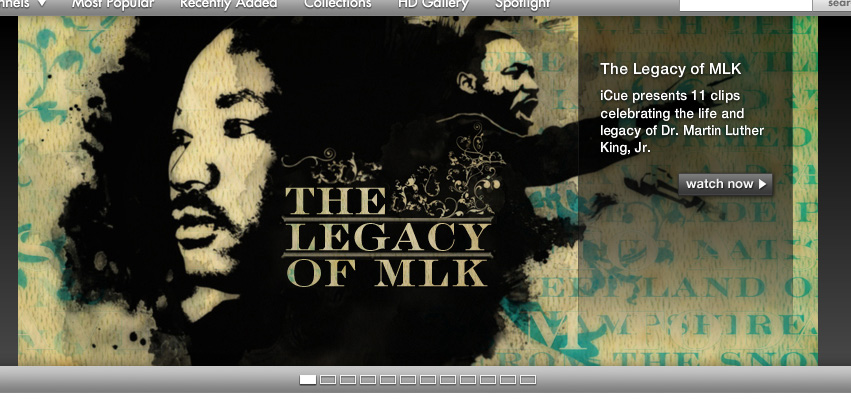
MLK – The Secret Hair-Do

I stopped by Hulu for another dose of Babylon 5, and found this on their front page:

Click to Enlarge

Click to Enlarge

I never knew MLK once sported a huge, fluffy afro.  But it works for him.

ASHoles site Redecorated

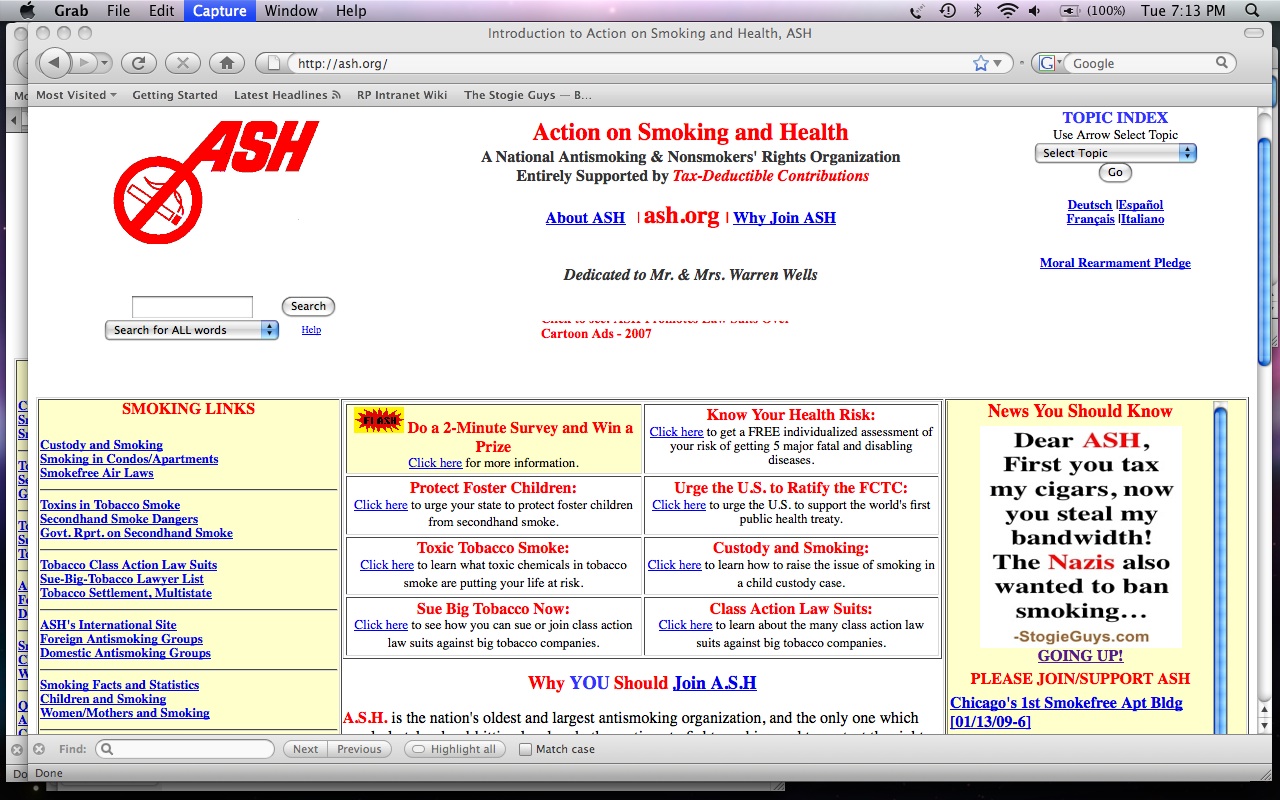
Action on Smoking and Health is one the most vile anti-smoker organization out there.  They sell kits to help nannies get smokers kicked out of their homes and make custody battles more contentious. They do this with a site almost as ugly as their black, shriveled souls.

Last week they made the rookie mistake of hotlinking an image from The Stogie Guys.  The Guys didn’t get mad, they got even, and for twelve hours the ASH site looked like this:

ash.jpg

Click for a larger image.

Missing the Obvious

A few days ago I went in for a medical examination, where the doctor boldly goes where no one has gone before.   Prepping consisted of stripping down to nothing but a flimsy hospital gown, lying under a flimsy blanket and getting an IV.

The nurse bringing me from the prep room to the examination room said, “The halls are pretty cold.  Would you like a warm blanket?”  I said, “Sure,” and she said “I’ll get one from the machine.”

It felt wonderful, warm all over, even better than crawling under an electric blanket on a cold winter night.  As I was wheeled into examination room I said to the doctor, “I want to get one of those blanket warming machines.”

She said, “You already have one.  It’s called a dryer.”

Congratulations to Scott Sigler on becoming a NYT Best Seller Author

Last summer two of the best parties at DragonCon were thrown by Podiobooks.com, one on Friday night, one on Saturday. It featured an open bar (donations accepted). At one point Scott Sigler was behind the bar and he poured me a beer. I said, “Someday when you’re a bestselling New York Times author I can say ‘Scott Sigler once served me a beer.'”

Scott Sigler is now a New York Times Best Seller author. Scott Sigler once served me a beer.

His book “Contagious” debuted at #33 on the NYT Best Seller list. And he got there by giving his stuff away. He also got there by writing a kick-ass novel – generosity won’t make a lousy book a success – but a lot of authors write kick-ass novels that never get published. Many who get published find their books languishing in the remainder bins. Scott’s counter-intuitive business model of giving his novels away via free podiobooks and PDF files built a huge fan base that helped this novel hit the bestseller list the first week it was published.

Congratulations on your success, Scott. You deserve it, not only for your great fiction, but for all the hard work you’ve put into promoting it and making it easily and freely available to everyone.

Farewell, Donald Westlake

Last week Donald Westlake, America’s best novelist, died at the age of 75.

His 100+ novels, all written on manual typewriters, covered different genres. Sometimes he used different writing styles. He wrote some fantasy and science fiction, but many of his books fell into two categories: small time crooks tangling with big time crooks, and rather ordinary people finding themselves in unusual situations that allowed them to enrich themselves by doing horrible things.

I’ve read dozens of his novels and throughly enjoyed every one. Two of my favorites are “Humans” and “The Axe.”

In “Humans” God is fed up with humanity and sends one of his angels to do some butterfly-effect tweaking that that will result in the destruction of the world. The Devil gets wind of it, and wanting to protect his choice gig sends one of his vilest demons to discover what the Angel is doing and stop him. The result is wonderfully disorienting – you’re cheering for the demon.

In “The Axe” a middle aged man is laid off from a highly skilled but very niche job. His life is falling apart, and after a few failed job interviews he decides to check out his competition. He places a fake ad in a trade paper and collects résumés. He finds six people who are his most likely competition, and then a thought occurs to him – what if something happened to them?

He becomes obsessed with the idea, and eventually, with a great deal of trepidation, kills one of them. He’s surprised how easy it was. The second one, though, is gruesome, barely a success. But now that he’s on a roll. . .

Like most of his novels about ordinary people doing evil things, the creepiest effect is your own reaction. The character seems so normal and likable you find yourself identifying with him, understanding his actions, and thinking, just for a moment, “I understand that. It doesn’t seem so bad.”

All of Westlake’s novels feature great characters, sharp dialog, plenty of action, intricate plots, and a healthy dose of humor. Be warned: If you read just one of them you will become hooked and want to read them all.