Using Scrivener to Write “World Of Tanks: The Missing Manual”

Note: This is not a beginner’s tutorial; it assumes you already know how to use Scrivner.

I got the idea for Blood Witness in the early eighties. I poked at it for a couple of years before I finally sat down and finished it. Then I spent another year on revisions and edits. I made a half-hearted attempt to find an agent before mothballing it. In 2009 I turned it into a podiobook, and then published as an e-book on Amazon in 2012. Total time from concept to publication: 30+ years.

I got the idea for World of Tanks: The Missing Manual, in April of this year. After thinking about it for a week or so, I pulled up Scrivner and started writing. It took about three weeks to complete the first draft. I spent another three weeks polishing and tweaking it, adding new content and creating diagrams. Then I sent it off to my volunteer editors/beta readers.

They sent it back with lots of suggestions and ideas. I implemented about 90% of them. For a final proofreading, I sent it to my daughter, who has never played the game, to see if she found anything confusing, and to find any remaining spelling or grammar errors . Her best catch: Referring to “public battles” as “pubic battles.” That would have made it an entirely different game.

After making the final corrections, I created a cover and uploaded the book to Amazon. Total time from concept to publication – less than four months.

That’s quite an improvement.


World of Tanks is a MMO where players drive around in vintage WWII tanks and shoot at each other. I’ve been playing it for a year or so. There are three classes of tanks, plus tank destroyers, plus artillery. There ten levels (tiers) of each vehicle, spread across six nationalities. There are hundreds of vehicles to pick from, each with their own strengths, weaknesses, and quirks. Vehicles can upgraded with improved modules, outfitted with equipment, and stocked with supplies (which are called “consumables”). Then there’s the crew, which improves with experience, and can be trained in various skills. And that’s just the tank part of the game. Players also need to learn battle tactics, how to manage the in-game economy, the best way to team up with other players, how to find and install game modifications (mods)…so yes, it’s complicated.

I wanted sections on tanks, crew, game economics, strategy and tactics, and a smart-ass glossary, so those were the first documents I put in the project. I started with the tanks, briefly describing the attributes of different nations and tiers. Then I added separate documents for each type of tank, followed by documents that covered different tank modules, equipment and consumables.

I’d usually start with a largish chunk, which I them broke down into separate documents. For instance, I had one document on consumables, which I then broke up by making each consumable a separate sub-document. Most of these documents were just a paragraph or two. I could see how well each one worked as a standalone piece, then, with one click, read the entire Consumables section as one long document. It was simple to juggle the order of each piece to get it just right.

Being able to jump quickly from document to document, adding a bit here and a bit there, made building the manual fairly easy. I’d be writing about, say, consumables, and that would remind me of something about the crew, so I’d click into that document, write, and that would call to mind a particular battle tactic, so I’d click to that document, and the whole book fleshed out rather quickly. When I wasn’t sure where to put something, I put it in an “Odds and Ends” folder. About half of what started there ended up in other places, and the rest stayed; Odds and Ends became a chapter in the book.

The logical order for the contents was Tanks, followed by Crew, Economics, Tactics, Mods, and Odds and Ends. But people would be downloading samples, and I wanted to give them something up front that would pique their interest and make them want to buy the book immediately. The Economics section has detailed advice on how to minimize the grind – the often-excruciating process of working your way though a lousy tank to unlock a good one. That was something that everyone would appreciate. I made Economics the first section of the book with a drag-n-drop.

I was about halfway through WoT:TTM before I gave any thought to labels. When writing fiction I use them to indicate character POV, which helps to see how the story is flowing, and use Status to indicate where a document is in the editing process. (To Do, First draft, Revised First draft, etc.) I’d been using status the same way with WoT:TMM, and wasn’t using labels for anything. About half way into the project I had an idea: why not use the labels for status instead?

Here are the colors I used:

Blog_Scriv_Wot_Labels

Now I could tell at a glance which parts needed attention, and what kind of attention they needed. It also created a rainbow in the binder, with the changing colors indicating progress.  The white (needs to be written) turned to bright red (first draft), then to light red (polished first draft), which turned to yellow, which turned to light green and then dark green, with occasional interruptions to remind me I needed to create diagrams or do more research.
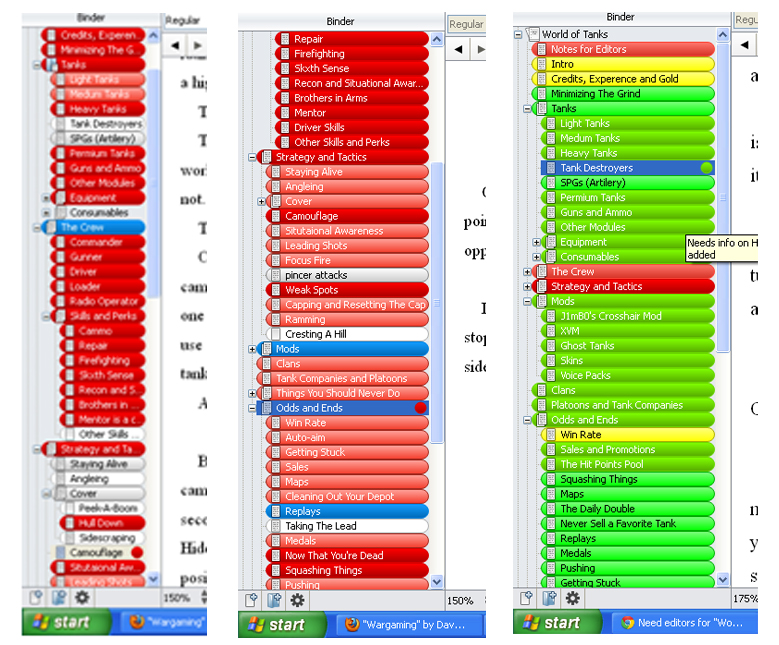
Blog_Scriv_Wot_Binder

The beta readers were World of Tanks players, and they found lots of small factual errors, and a few big ones. Some suggestions required major revisions and additions. The binder became more yellow as I made them.

After making the changes I printed the whole thing out on paper and went through it line by line, reading out loud, looking for and correcting anything we’d all missed. As I finished each section, I changed the labels to light green, then sent it off for “final” daughter-edit.

I exported it into an RTF format, then to a Word format, and then into Jutoh, a program that makes producing the final e-books fairly simple. (Yes, I know Scrivner can export to an e-book format, but I prefer the flexibility of Jutoh.)

After publishing it, some of the reviews mentioned spelling/grammar errors, so I sent it to yet another editor, Johnny Virgil, who caught several errors that all the rest of us had missed.


My biggest writing nemesis is distraction. The two main sources of distraction are research and clumsy phrasing.

In a scene that takes place in the mid-80s, a character was drinking Johnny Walker Black. But wait, was that available then? I looked it up, and no, it wasn’t. So I needed to have him drinking a different premium scotch. Should it be something common, or more esoteric? I thought esoteric, but not too esoteric, would be the right choice. That led to looking for reviews and information about scotches of all sorts. I looked at the clock and found I had spent an hour researching that one sentence.

Sometimes it takes far too long to re-work a clumsy sentence. Fixing it, getting it just right, can break my workflow and waste a lot of time.

My solution to both problems is highlighting. If I need to research something, I highlight the sentence in pink. I change the status to “needs research,” except for this project, where I used the label instead. Knowing it will be easy to find and fix the problem later makes it easy to keep writing without getting stalled. The same process works for clumsy phrasing or the not-quite-right word. Those get a yellow highlight in the text and the appropriate status (or label) change.

World of Tanks: The Missing Manual is selling well on Amazon, and getting good reviews. I intend to update it on a semi-regular basis. The game is updated several times a year, which means some of the info in the manual will become outdated, and I keep learning new things I’d like to add. I’ve already started making changes and additions, and the color-coding in the binder makes it very easy to see which sections have been changed or added, and how much work each piece needs. When I’m ready to publish the new version, I’ll be able to pull out the changed/added documents and send them to my editors instead of having them go through the entire book again.

I could have written the whole thing in Word, but it would have frustrating and taken longer, probably much longer. Scrivner made it much easier, and more importantly, helped make it a better book.

Service Experts Ripoff

Eight years ago, Roland J. Down, a large local company, installed a new heater and air conditioner in my home. I’ve had them do a few annual inspections since then, so a week ago, when the air conditioner died during a heat wave, I gave them a call. 

The repair guy showed up on time, diagnosed the problem immediately, and fixed it quickly. I was surprised that his truck said Service Experts instead of Roland J. Down, but that seemed trivial. I was very happy, until after he left. I did a quick search for the part he replaced and saw what it cost, compared to what they charged me.

Evidently, most of the local heating and cooling contractors have hooked up with Service Experts. I don’t know if it’s a franchise or if Service Experts bought the businesses. I do know that I was ripped off.

They didn’t have an e-mail address, so I filled out their “Contact Us” form and sent them the following letter:

Last week I called for service on my air conditioner, expecting it would be a day or two before you could send someone out. I was pleased when you told me you could have a technician here in a couple of hours.

He arrived on time, and when I told him what the symptoms were, he said, without hesitation, “It’s probably the capacitor.” He checked the unit, took one look at the capacitor, and said, “That’s the problem. I can tell just by looking at it.” He got a replacement part from the truck and fixed it quickly. It took him about fifteen minutes, total. Then he checked the unit in my basement, did some tests, and said everything was working fine. He did is job quickly and well.

We then had an informative conversation about the best way to save on both my heating and cooling bill.

The bill was $267 dollars. The fee for the call was $99, which is reasonable, but the capacitor seemed overpriced at $174 dollars. Using the old part as a reference, I looked it up on-line, and found I could by it, retail, for less than twenty dollars. I know and accept that repair services have high markup for parts. Markups of 100% are common. Some places charge 200%. But 835%? $174 for a $20 part? That’s ridiculous. That’s insane. That’s a complete rip-off.

Let’s leave out the fact that you’re buying these in bulk, and no doubt playing far less than the retail price. We’ll just pretend that you’re paying twenty bucks for them. Let’s also agree that a 100% markup is acceptable, making my price for the part $40. With these generous assumptions, you’ve overcharged me by $134, plus tax. I would like a refund of that amount.

I realize that I agreed to that price, and paid it, and that if you refuse to humor me there’s nothing I can do about, other than share this story with my friends.

But I have a *lot* of friends.

I await your prompt response.

Regards,
Dave Hitt

That was more than a week ago. I’ve received no reply, so this is step one of letting all my friends know what to expect. If you call anyone affiliated with Service Experts you can expect prompt, competent service, and you can also expect to be royally screwed on parts.

This is the part:


Service Experts Ripoff
As I said in the letter, I don’t mind paying $99 for the service call. The fact that it only took him fifteen minutes to replace it and then test the system doesn’t matter – I was paying for his expertise. But paying $174 for a $20 part – that matters.

Now I know what to look for, and how simple it is to replace. If it goes again I’ll be able to fix it myself for twenty bucks. I wouldn’t have minded paying $140 to learn that. But $274? That guarantees I’ll never again call Roland J. Down, or anyone else affiliated with Service Experts.

The next time I have a problem with my system, I’ll call a local, unaffiliated contractor. Sorry, Service Experts, you only get to screw me once.

Sanjay Sanghoee v. Libertarians

This is in response to this article, so please read it first.

There’s no excuse for this level of ignorance – he could have cured it with a ten-minute Google search or a fifteen-minute conversation with an actual libertarian. Even the URL, which contains the phrase “libertarian-tea-party,” is wrong. (Most likely, it’s an attempt to manipulate SEO.) Pointing out all the errors Mr. Sanghoee’s article contains would require an article at least three times a long as his, so I’ll just point out a few of them.

Libertarians never took pages from the progressive playbook, nor from any playbook other than their own. We seek individual liberty, which naturally includes things like gay rights and ending the drug war. Libertarianism also lines up with some conservative causes, like gun rights and smaller government, but that too is happenstance. When you start from the principle that people own themselves (the core principle of the philosophy) and work up from it, some conclusions come out on the right side of the political spectrum, some on the left. This confuses people like Mr. Sanghoee, who evidently can only understand the false dichotomies of Left v. Right or Republicans v. Democrats. Libertarians reject that inaccurate two-dimensional view of politics. Our view includes the third dimension of liberty v. tyranny.

Libertarians are strongly in favor of free trade, and are opposed to military interventions and war.  A few minutes of research would have saved Sanjay from the embarrassment of making the uninformed claim that libertarian foreign policy would, “would hurt us in every way imaginable.” Libertarians would like a world where nations trade and cooperate with each other instead of using bombs and robot death planes to murder people.

Sanjay’s insistence that Rand Paul and the Tea Party are libertarian proves he has no clue what Libertarianism is. He doesn’t hate libertarians; he hates what he imagines them to be, which isn’t even close to reality. It’s like someone saying they hate Justin Bieber because they can’t stand progressive jazz. And while lefties will read his nonsense and nod in agreement like a Michael Moore bobble-head doll, anyone with a clue will just shake their head in disgust and write off Mr. Sanghoee as just one more ignorant lefty who has absolutely no idea what he’s talking about.

I Don’t Want to Go to Heaven

Last week the pope announced that atheists might go to heaven. To which I replied, “How dare you threaten me!” 

He was wearing his pretty white dress with 24 carat gold trimmings and enough gold jewelry to make Liberace jealous, surrounded by other men wearing similarly fabulous attire. He took a break from condemning gayness to proclaim:

“The Lord has redeemed all of us, all of us, with the Blood of Christ: all of us, not just Catholics. Everyone! ‘Father, the atheists?’ Even the atheists. Everyone! … ‘But I don’t believe, Father, I am an atheist!’ But do good: we will meet one another there.”

Why would an atheist want to go to heaven? There’s nothing to do there. Sure, their version of Handel’s ‘Messiah’ has got to be amazing, but after two or three listens you’re going to want to hear some Allman Brothers, and they’re not up there. Does heaven have steaks, cooked to perfection with just the tiniest bit of perfect seasoning? Cuban Montecristos and Cohibas? Craft beer and fine Bourbon? Hot and willing women? No, no, no, and hell no. Heaven, heaven is a place, a place where nothing, ever happens.

Wait, what’s this?

atheists going to hell

Whew. That’s a relief. They had me scared for a minute there.

This, my friends, is what heaven should sound like. It doesn’t, but that’s OK, because can listen to it right now, here on earth.

It Doesn’t Take A Village

She looks harmless, but listen to what she has to say about your kids.

This is Melissa Harris-Perry, a professor of political science and spokesweasel for MSNBC, telling us that your kids are not your kids – they’re everyone’s kids.

And she’s not alone.

We’ve been hammered with the slogan, “It takes a village to raise a child” ever since Hillary Clinton hired someone to ghost-write her book. It’s an African saying that might make sense for people living in a culture composed primarily of tribes of extended families, but in the context of our society, it’s both stupid and frightening. It doesn’t take a village; it takes parents, preferably two. An extended family helps too. But Harris-Perry wants the government to have the primary say in how you raise your kids. Considering how well government does everything else, that should strike a deep black fear into the heart of very mother and father in the US.

She does this after complaining that we don’t spend enough on public education. The fact is, adjusted for inflation, we’ve tripled our spending per student since 1960, and the results have been appalling. For instance, it produces academics like Ms. Harris-Perry.

There are a thousand different ways to raise kids, and only about a dozen of them are wrong. Unless someone is actively hurting their children, they should be left alone to do what they think is best for them.

What about hard-core fundamentalists whose homeschooling curriculum consists of coloring books featuring Jesus riding dinosaurs, lessons on hating gay people, and believing that the world is going to end next week? Leave them alone. I think they’re foolish, and I know they’re wrong, but I support their right to raise their kids their way. I say this as a hard-core atheist and despite being raised in a fundy household and hating every minute of it. It sucked in every way imaginable, but if Big Brother came in and tried to “fix” it, it would have been even worse.

I raised my kids to be critical, thinking people who don’t take things at face value. I taught them to love liberty and be wary of the numerous people, organizations and governments that will try to take it from them. I didn’t consciously try to steer them toward being atheists, but that’s how they turned out. (Surprise!) I think all kids should be raised that way. So why would I support the right of parents to teach their kids wrong, stupid, and downright harmful things?

Several reasons. The first, and most important, is that it’s none of my damn business. They’re not my kids. Nor are the “society’s” property. The second is that it’s the only way to support the rights of everyone else, including skeptics and atheists, to raise their children the way we want. You can’t demand that right for one group and deny it for another because you disagree with them. And finally, I don’t know the best way to raise your kids. I got my one chance to raise mine, and they turned about great, but I’m not presumptuous enough to insist my way is best, and not not evil enough to force others to use it.

Ms. Harris-Perry, however, is.


More Information:

For a more detailed breakdown of this vile creature, check out William Grigg’s article. I’ve just added his blog to my intentionally short blogroll. (I disagree with his position on abortion, but not much else.) I read it regularly, and so should you.


A Decrease of the Increase

Imagine you’re sitting in your boss’s office for your annual performance review. Your boss says you’re doing well, you’ve improved in several key areas, you’ve contributed to the bottom line of the company, but you need to work on keeping your voice down in your cubicle and try to fart less. (Oh, wait, that was my last performance review, not yours. Sorry.) He tells you that he’d been planning on giving you a 6% raise, but because of budget issues he can only give you a 5% raise. 

Would you freak out? Would you bitch and moan about how many things your family was going to have to cut back on?

This is exactly what’s happening with the sequester “cuts”. (Well, not exactly. Government hasn’t improved, not even a little.) We’re told that horrible horrible things are going to happen because there was a small decrease of the increase in the budget.

The administration is doing everything they can to make the cuts painful. When Charles Brown, a director at the Department of Agriculture ‘s Animal and Plant Health Inspection Service [APHIS] was asked about about managing the cuts to minimize the impact, he replied, ““However you manage that reduction, you need to make sure you are not contradicting what we said the impact would be.” In other words, make it hurt.

Meanwhile, the same agency is planning a conference described as “a “mouthwatering event” featuring “fine wines and exceptional micro-brews paired with seasonally driven culinary delicacies.” Good thing they’re not cutting back on anything important.

Whenever my local school district wants more money, which they can only get by convincing us to vote for even higher property taxes, they always threaten to cut sports and music programs. Always. They never try to cut the six-figure salaries of administrators – they don’t even like to admit those exist. Instead they try to trigger an emotional response to con us into forking over even more.

The Obama administration is pulling the same kind of stunt, shutting down White House tours and threatening other programs that people respond to emotionally. The fact that this is a decrease of an increase is largely ignored by Obamafans, but even some Democrats are cringing at the stupidly being spewed. My favorite, so far, is Maxine Waters’ claim that the cuts will cost 170 million American jobs. Cool trick, considering that there are about 155 million jobs in the country. We’ll have 110% unemployment!

Smaller government is generally better government, but this doesn’t cut things nearly enough to make any real difference. When I become president the first thing I’ll do is a 25% across the board cut for nearly every federal agency, and the wholesale elimination of at least 10% of them. I can’t wait to hear Maxine’s response to that.

Responding to A+ Accusations

Last year a group of atheists and skeptics decided that the only correct mode of thought was far left humanism and militant, man-hating feminism. They created the A+ movement as a response to those who dared to push-back against their nonsense. Their occasionally interesting blogs were transformed into cesspools of self-righteous name calling. They drove their most interesting writers away, leaving behind a relativity small group of miscreants who spend most of their time searching, searching, searching for something they can whine about. In nearly every case they misrepresent what the author actually said. Context doesn’t matter. Intent doesn’t matter. The author’s history and record and previous writings don’t mater. The only thing that matters is that someone feeds their desperate need for attention.

The most prominent among them are Rebecca Watson and PZ Meyers. In the past they occasionally provided insights and interesting takes on things, but these days they and their cronies spend most of their time desperately looking for something to be offended by and pissed off about.

The rift they created is now being discussed in the mainstream press, making the entire atheist movement look bad.

There are two ways to feel good about yourself. The first is to actually accomplish something. It can be something great or something trivial, but as long as it’s something you can be proud of, you can point to it, say, “I did that,” and feel good about yourself.

The second way is to look down on other people. We all do it to some extent, but some people use it as their primary source of self-esteem. They convince themselves they are morally superior to anyone who disagrees with them. They often season their disdain with a persecution complex.

The A-plusers have mastered the second technique. They carefully examine everything said or written by any atheist or skeptic outside of their self-important clique. The moment someone says anything they don’t like (and they don’t like much), they go into attack mode. They call out the offender by name, twisting their words out of context to present them in the worst possible light.

The natural response by those attacked is to defend themselves. They spend a great deal of time and effort explaining what they really meant, often inducing a detailed personal history that counters the accusations. This is the natural, obvious response to this kind of attack, but I’d like to suggest a different approach.

Ignore them.

Every time you address their spurious arguments and deeply dishonest accusations, they get the attention they crave. You’re training them that they can remain the center of their own universe simply by stirring up shit wherever the attention starts to fade.

Ignoring them very, very difficult to do. Our natural response, especially to potentially reputation-damaging accusations, is to defend ourselves. But every time we do it, we’re training them to keep flinging poo in our direction.

I made this suggestion to someone they’d targeted, and she replied that it was important to defend herself. She does a lot of freelance work, and was concerned that a potential client or employer would run a search on her name and see the accusation. If she didn’t respond she might lose the gig.

This is a legitimate concern. A friend lost two paying gigs because someone Googled his name and was offended by a conversation the two of us had on this very blog. (I made a change that removed it from Google’s radar.) I’m sure I’ve missed being hired once or twice because someone Googled my name and was offended by some opinion I’ve expressed here or elsewhere on the web. The only sure way to avoid that is to keep quiet on the net, which isn’t in our nature.

But in the long run defending yourself against these bogus accusations from the A-plussers is counter-productive. It inspires them to repeat their dishonest behavior. Linking back to their accusations improves their search engine ranking, making it more likely their nonsense will come up when someone searches for your name.

Some of the people pulling this crap achieved their original prominence by offering insights and worthwhile conversations, but now they’re like poorly mannered children at an adult party.  They are jumping up and down in the living room, waving their arms and shouting nonsense in a desperate attempt to get the grownups to abandon their conversations with each other and pay attention to them.

Don’t feed the beast. Dismiss them as you would a any other tiresome troll. It’s not easy, especially when they mention you by name, but it’s the only way to get rid of them.

“Oh, it’s just Rebecca Watson. Pffft. Did you like the latest Bond movie?”

“Oh, it’s just PZ Meyers. Ho hum, what’s for dinner?”

“Oh, it’s an A-Plusser making noise? Not now, I’m having a conversation with the grown-ups.”